
Discontentment in homemaking and motherhood is a common topic of conversation in today’s culture, especially among stay-at-home moms. While I am not totally certain of the reasons for this, I would hasten to guess that part of the reason is because it has become so normalized to express discontentment in this area of life.
To be honest, I have not felt what I would consider real discontentment with being a stay-at-home mom. I worked for a short period of time after my firstborn, and I know I would much rather be with my children fulfilling my role as their mother 100% of the time, than to be working outside the home. I am grateful for that experience, though, because I likely would struggle more with discontentment as a homemaker if I had not experienced the alternative.
However, I have felt guilt and insecurity about not contributing financially to our family. I have also felt a great deal of discontentment in the day-to-day tasks that are before me to do. Because, to be honest, there are many things I would rather be doing than dishes and laundry! Therefore, I do feel I have something I can share and contribute to this conversation.
With all that said, I want to take this article in a different direction. While I am a homemaker–and I am writing an article on overcoming discontentment, I want to approach this as the universal human issue that it is. If you have experienced discontentment as a stay at home mom, this is because you are human–not because you are a stay at home mom.
What I mean by this is that feeling discontentment, healthy or unhealthy, is not unique to the homemaker. Husbands can experience discontentment in their work, students can experience discontentment in their studies, as can retired older adults, children, single people, married people, the wealthy, and the destitute. It is a universal experience because of the state of our human natures, and we each must tackle it the same way–by going to the scriptures and seeking God.

Discontentment is a human issue…not a motherhood issue!
Healthy vs unhealthy discontentment
This may seem like a backwards statement to say that there is such a thing as healthy discontentment, but allow me to explain myself. There is a type of discontentment that drives a person towards growth. We would equate and understand this as ambition. When this begins to cross the line into sinful discontentment or selfish ambition is when it leads the person to begin feeling covetous, ungrateful, or prideful. Ambition, although it may start out honorably, can also cross the line into sin just as discontentment can. “Let nothing be done through selfish ambition or conceit, but in lowliness of mind let each esteem others better than himself.” Philippians 2:3
However, no Christian would say that we should be content with sin, or with staying stagnant in our faith, or with laziness, or complacency. There is a difference between Biblical contentment and complacency. Contentment in the heart of the Christian drives out ingratitude, covetousness, selfishness, and pride. Complacency fosters laziness and a lack of growth while often even opening the door to those very same heart issues that contentment drives out.
This type of discontentment with complacency often comes in the form of conviction or a biblical desire for the things of God. Sometimes our soul is discontent for a reason, and it is because there is something we need to get right with God. Allow me to give some biblical examples of what we should be discontented with.
- Sin: “What shall we say then? Shall we continue in sin that grace may abound? Certainly not! How shall we who died to sin live any longer in it?” Romans 6:1-2. Secondly, Jesus’ words on this subject are even stronger in Matthew 5:29 “If your right eye causes you to sin, pluck it out and cast it from you; for it is more profitable for you that one of your members perish, than for your whole body to be cast into hell.”
- Being stagnant in our faith: “For though by this time you ought to be teachers, you need someone to teach you again the first principles of the oracles of God; and you have come to need milk and not solid food.” Hebrews 5:12.
- Laziness: “Go to the ant, you sluggard! Consider her ways and be wise, which, having no captain, overseer or ruler, Provides her supplies in the summer and gathers her food in the harvest. How long will you slumber, O sluggard? When will you rise from your sleep? A little sleep, a little slumber, a little folding of the hands to sleep–so shall your poverty come on you like a prowler, and your need like an armed man.” Proverbs 6: 6-11.
- Complacency: “For the turning away of the simple will slay them, and the complacency of fools will destroy them;” Proverbs 1:32.
- Not serving the Lord: “Therefore, my beloved brethren, be steadfast, immovable, always abounding in the work of the Lord, knowing that your labor is not in vain in the Lord.” 1 Corinthians 15:58.
So my first exhortation for you, if you are dealing with an attitude of discontentment, is to take a minute to consider if one of the above areas is something you need to grow in. Instead of letting discontentment drive you to look outside to the world for greener grass, use it to drive you closer to God.
These ideas: contentment, discontentment, ambition, and complacency, are so intertwined in the heart of humanity, that it is necessary to examine ourselves. We must align our hearts with contentment and godly ambition, and ensure we are not slipping into a false sense of contentment paired with complacency or a selfish ambition paired with a discontented heart. Now, to address the sinful discontentment.

How discontentment manifests itself in sin
Sinful discontentment often manifests itself in one or more of these heart issues: self-centeredness, covetousness, pride, or ingratitude. The Bible warns us strongly of these heart issues, and commands us to deal with them. In Exodus 20:17, part of the ten commandments, we are told:“You shall not covet your neighbor’s house; you shall not covet your neighbor’s wife, nor his male servant, nor his female servant, nor his ox, nor his donkey, nor anything that is your neighbor’s.” An envious heart for “anything that is your neighbor’s” is going in direct disobedience to God’s command. Let me take this a step further and say: maybe that’s not just things. What if that’s also referring to things like time, types of relationships, experiences, or abilities. How often do we look outside ourselves, and allow our hearts to dwell on thoughts like: man I wish I had time to do that fun activity with my kids… I wish my family was that close… insert your own “greener grass”.
Colossians 3:5 tells us, “Therefore put to death your members which are on the earth: fornication, uncleanness, passion, evil desire, and covetousness, which is idolatry.” Covetousness is literally idolatry: putting something in the place of God. Allowing our discontentment to drive us toward desiring after these lesser things is establishing an idol in our heart. Ouch!
When we allow discontentment to cause us to desire what we do not have, it displays ingratitude to God. Hebrews 13:5 tells us, “Let your conduct be without covetousness; be content with such things as you have. For He Himself has said, ‘I will never leave you nor forsake you.’” If all we had in life was God’s love for us and the hope of eternity, we would still have so much to be grateful for! The following verse goes on to say, “So we may boldly say: ‘The LORD is my helper; I will not fear. What can man do to me?’” God is our helper. He will not leave us. Why would we throw ingratitude and discontentment in His face…why do I throw ingratitude and discontentment in His face?
Ultimately, the root issue is selfishness. If we are constantly looking at ourselves and what we perceive as lacking, it breeds ingratitude. However, when we practice gratitude, and we look at how we can be a blessing to those outside ourselves, it drives out these sins in our heart. This gives us a segway into my final point. What do we do about this? What is the antidote to discontentment?

The antidote
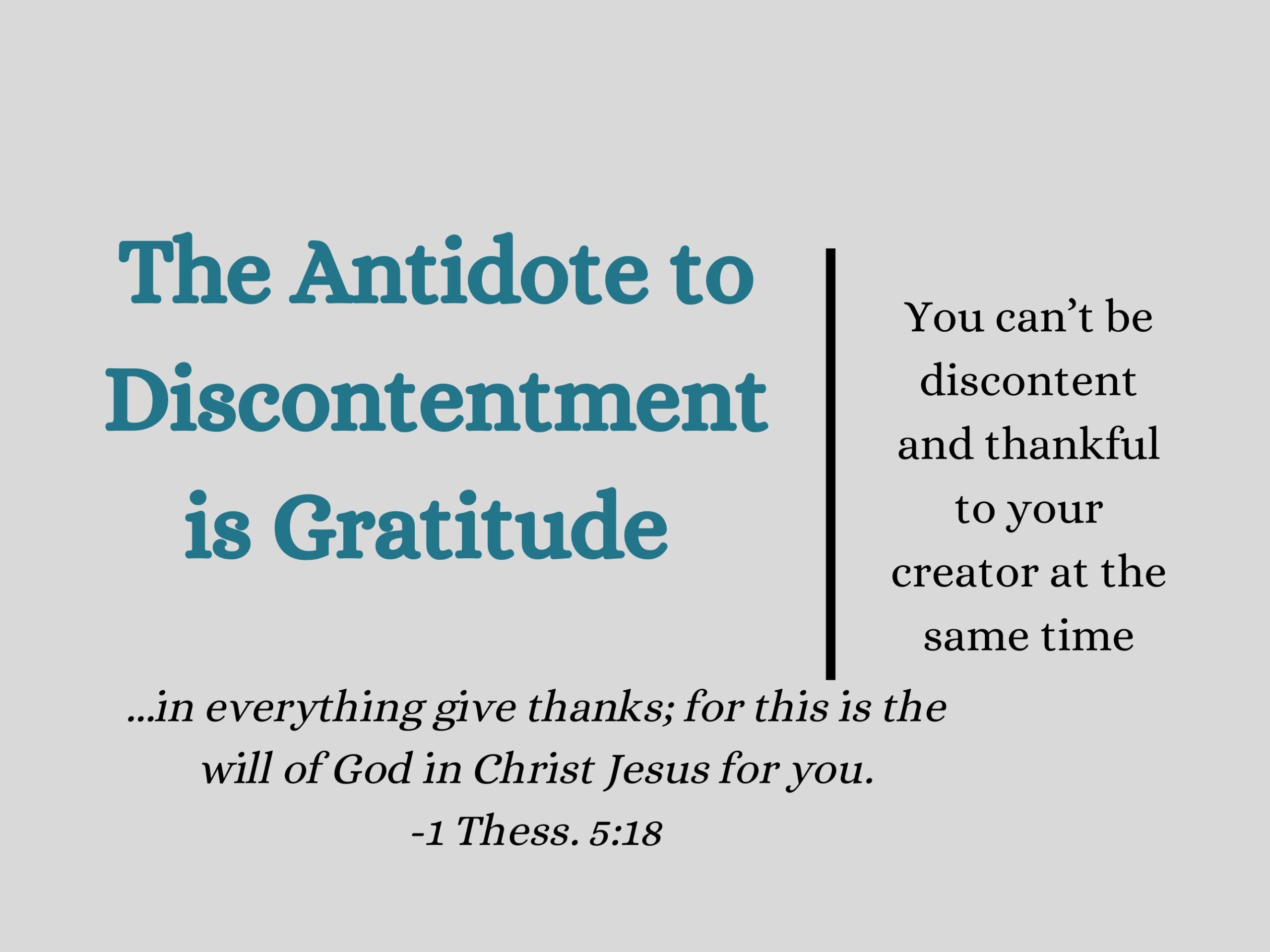
You could probably guess what I am going to say. Gratitude is the antidote to sinful discontentment. It is not possible to be sinfully discontent and thankful at the same time. Consciously making the decision to be grateful and making a point to thank God for His numerous blessings in our lives changes our heart. We are moved from looking at all the areas of need or wants that we see in our lives, to looking toward God and His faithfulness. After all, like we read in Hebrews, we have a God who has promised not to leave us or forsake us. We have so much to be grateful for. Paul exhorts the Thessalonian church to “Rejoice always, pray without ceasing, in everything give thanks; for this is the will of God in Christ Jesus for you.” (1 Thessalonians 5:16-18). God is pleased with our grateful hearts. You would understand this if you have children, and have ever taken great joy in seeing them express gratitude and thankfulness for a good gift you’ve given them.
How do we maintain a thankful heart? The best and truly most practical advice that I can give is to pray for the Holy Spirit’s help. Pray for His conviction in your heart when you have adopted an attitude of discontentment. Pray for Him to open your eyes to the blessings all around you, and pray for Him to give you His steady, ever-present peace. Philippians 4:6-7 is a great reminder of this, “Be anxious for nothing, but in everything by prayer and supplication, with thanksgiving, let your requests be made known to God; and the peace of God which surpasses all understanding, will guard your hearts and minds through Christ Jesus.” Pray for the Holy Spirit to guard your heart and mind! This is something I am continuing to learn for myself. Relying on God’s strength and not my own is not an easy thing to remember to do, and I fail to do it way more often than I remember and choose to depend on Him.
However, with the Holy Spirit’s help, we can experience the contentment Paul describes in Philippians 4:11-13. Even on our hardest days, when we feel completely depleted and “poured out,” God can give us the strength to position our hearts toward gratitude. Take a look at Philippians 2:17-18, “Yes, and if I am being poured out as a drink offering on the sacrifice and service of your faith, I am glad and rejoice with you all. For the same reason you also be glad and rejoice with me.” What if we asked the Holy Spirit’s help to position our hearts with this attitude toward our children? In motherhood, there are days when you just feel depleted, but how wonderful is it that God has blessed us with these mini versions of ourselves to love on and care for. How amazing is it that God has entrusted us with the holy and sanctifying task of raising up souls for His kingdom! For this we ought to be humbled and thankful. Reminding ourselves of the importance of this calling inspires us to rejoice within, instead of reject, the feeling of being “poured out” in motherhood.
So, how do we root out the discontentment in our hearts? By replacing it with thankfulness to our Lord and Savior. To close, I will give three very practical action steps for anyone who has read this far, and I will be closing my computer and completing these steps myself.
1) Turn off the device on which you are reading this post and leave it out of reach of yourself for at least the next 10 minutes.
2) Pray and thank God for all that He has blessed you with. Ask for His help to direct your heart toward contentment.
3) Set a timer, and for the next 10 minutes make it your focus to “take your thoughts captive,” (2 Corinthians 10:5). Notice the things in your life that you have to be grateful for, and as you think of them or see them, thank God for them.
“Be anxious for nothing, but in everything by prayer and supplication, with thanksgiving, let your requests be made known to God; and the peace of God which surpasses all understanding, will guard your hearts and minds through Christ Jesus.” – Philippians 4:6-7
The Holy Bible: New King James Version. Thomas Nelson, Inc., 1982.
Leave a Reply