
As a Christian who regularly lacks trust in God and wants to feel like I am in control of my circumstances, I feel unqualified to write a post on trust. However, I knew it was a necessary follow up to my post on biblical decision making. Having battled with trust, and found comfort in God’s word I can share what has encouraged and reminded me to relinquish control to God in various seasons of life.
As we balance discernment and make decisions regarding questions in motherhood, it is absolutely necessary to foster a heart of trust in our heavenly father. Otherwise, we will be weighed down with the cares of this world. In my previous post, I outlined 5 steps of the biblical decision-making process, but I didn’t address what you do when you have a question that you just can’t find an answer to. Even further, I didn’t address what to do when you realize that what you thought you could control is actually out of your hands. Sometimes in motherhood, all the prayer, bible study, counsel, and research, still leaves you with questions, and that is when you must sit back and realize God is in control.
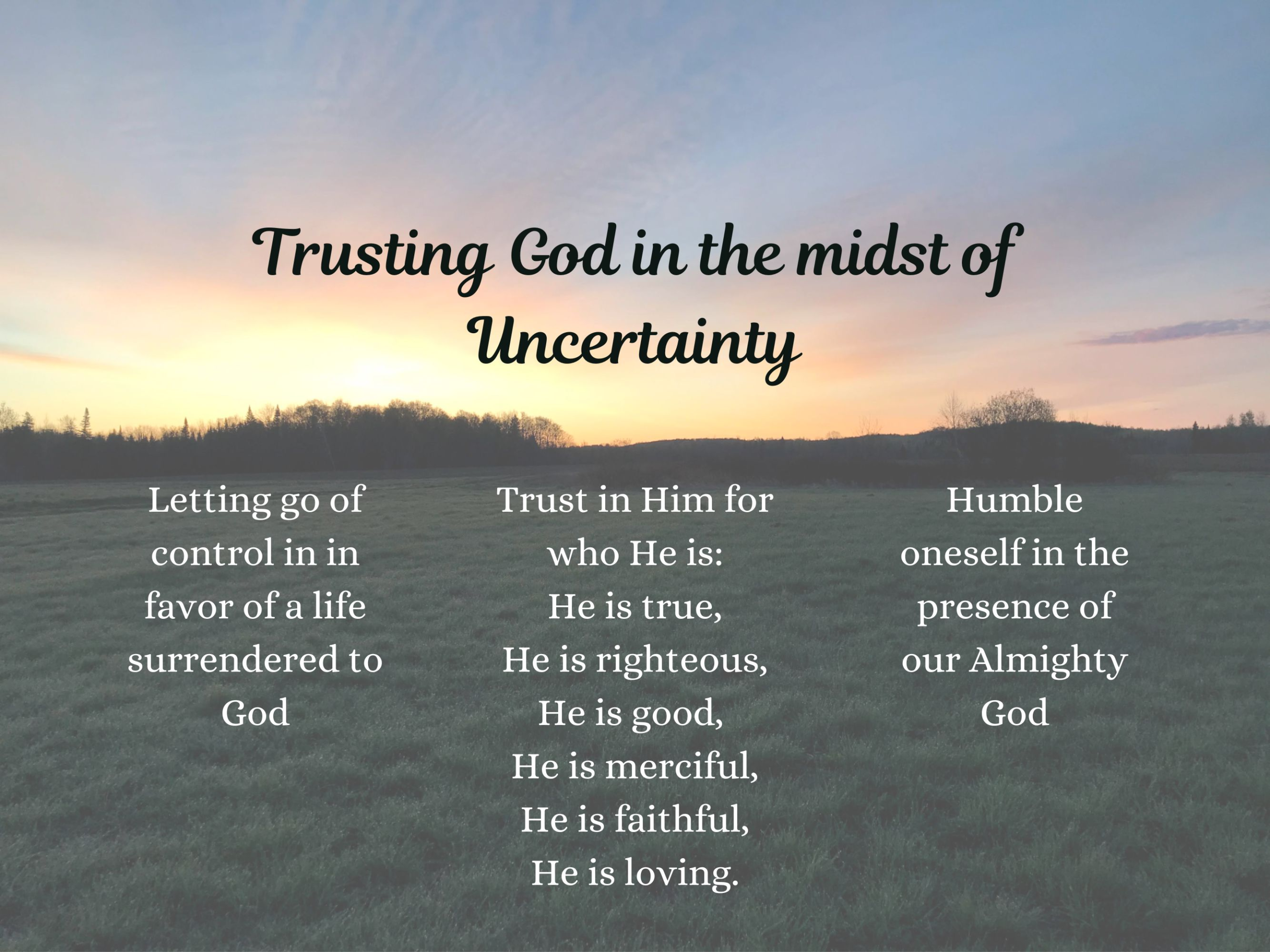
I’m going to tackle those ideas today by using Scripture to remind us of who we are, who God is, and why we can and must trust Him. In doing so, I exhort you to dive deeply into your own bible study on the topics of trust. We know that the Bible exhorts us to trust in God numerous times, and we take peace and comfort in those verses. However, I want you to think of trusting in God as a response to deeply knowing who He is. Genuine trust is not forced; it is the result of a heart that is humbled in the presence of God- recongizing His goodness and our dependence. My trust in Him is most strongly fortified when I am meditating on His trustworthiness, and I am honest enough to admit my need.
Who are we?
Ever since the fall, human sin nature has rampaged the world. Rooted deep in the sin nature of man is the subtle belief that we can be our own God. Satan tempted Eve with the idea that eating the fruit they were forbidden would make them, “like God” (Genesis 3:5). This idea that we can rule our own lives pulls at us in various ways as long as we’re living, and it clouds our minds to the fact that we are frail dust in comparison to our creator (Psalm 103:14). Unless firmly rooted in the Word of God, and able to recognize our human frailty, we will be drawn away from reliance on our Heavenly Father and toward a grasping of control in our life.
The Psalms are a wonderful, poetically written picture of human frailty compared to God’s holy sovereignty. Take a look at Psalm 39:4-5, “LORD, make me to know my end, and what is the measure of my days, that I may know how frail I am. Indeed, You have made my days as handbreadths, and my age as nothing before You; Certainly every man at his best state is but vapor.” Speaking also to the brevity of the human life, Isaiah 40:7-8 states, “The grass withers, the flower fades, because the breath of the LORD blows upon it; Surely the people are grass. The grass withers, the flower fades, but the word of our God stands forever.” Another great picture of who we are before God is found in Isaiah 64:6-7. I won’t write it out here, but please read it. Very clearly these verses demonstrate the brevity of our life, the insignificance of our “righteous acts”, and the issue of sin in the human life.
The story of Job is a powerful example of spiritual warfare, “unexplained” loss, worshipping God through grief, and ultimately repentance before our holy God. While a difficult and sometimes hard to understand read, no one can deny God’s holiness and man’s frailty when they read chapters 38-42. I challenge you to do so, and to take note of Job’s responses to seeing the power of God displayed. Job 40: 4-5, “Behold, I am vile; What shall I answer You? I lay my hand over my mouth. Once I have spoken, but I will not answer; Yes, twice, but I will proceed no further.” And again in chapter 42, “…I have heard of You by the hearing of the ear, but now my eye sees You. Therefore I abhor myself, and repent in dust and ashes.” Even the most righteous man must repent and humble himself before the almighty God.
Take a look at what James has to say on the matter: “Come now, you who say, ‘Today or tomorrow we will go to such and such a city, spend a year there, buy and sell, and make a profit’; whereas you do not know what will happen tomorrow. For what is your life? It is even a vapor that appears for a little time and then vanishes away. Instead you ought to say, ‘If the Lord wills, we shall live and do this or that.” (James 4:13-15). Our days, our plans, our dreams, and even our children are ultimately in the Lord’s hands. We can plan all we want, but ultimately it is up to the Lord to bring things to fruition (Proverbs 16:9).
Ultimately the point is we do not have the control over our lives that we think we do. We are weak, small, sinful people who have no idea what tomorrow will bring. We are at the mercy of our Creator, and it is a good thing that is the case because of who our Creator is!
Who is God?
As you read the Bible, I encourage you to ask yourself: what is this passage telling me about God? All throughout scripture, wherever you look, you will find a God who keeps his promises, has ultimate authority and power, never acts unjustly, and has the deepest love you could ever imagine. These are just a few of His many characteristics on display over and over in the word of God. Even the geneologies tell us that God is a God of order, organization, and record. He is One who knows our names- this is yet another reason to trust Him! If you struggle with trusting Him wholeheartedly, then constantly reminding yourself of these truths will help you to be assured of His trustworthiness and your need for Him. From that place, a deeper trust and reliance on God can be formed.
First and foremost, God is righteous; everything He does is right, true, and just. Psalm 11:7, “For the LORD is righteous, He loves righteousness; His countenance beholds the upright.” Psalm 145:17, “The LORD is righteous in all His ways, Gracious in all His Work.” I encourage you to read all of Psalm 145 about the greatness of God. He does not do anything unrighteously, He is holy and perfect in all of His ways. For this we know we can rely on Him.
I referenced Isaiah 64:6-7 earlier in relation to us, and now I’m going to look a few verses further in relation to God. Isaiah 64:8, “But now O LORD, You are our Father; We are the clay, and You our potter; and all we are the work of Your hand.” He is our Father. He made us, and is continuing to shape and grow us. He is Lord over us. He is actively working on us, sanctifying us and growing us in faith, and He promises to continue (Philippians 1:6).
Read Psalm 34. I was going to quote verses from it, but as I read the chapter I could not choose just a few to highlight. So, again, I invite you to read the whole chapter, and I will highlight what it shows us about God. God hears us. God delivers us. God saves us and protects us. God is good. God cares and provides for us. God sees the righteous and the wicked. God is near to the brokenhearted and contrite. God redeems.
God is compassionate, merciful, and gracious. Psalm 145:8-9, “The LORD is gracious and full of compassion, slow to anger and great in mercy. The Lord is good to all, and His tender mercies are over all His works.” God is loving toward us, and that is the very reason He sent his Son to redeem us from our sins that we might spent eternity with Him. His holiness cannot be separated from His compassion and mercy. In His holiness He has had mercy on us, to provide a way of salvation. If we trust Him with our salvation, why wouldn’t we trust him with our day to day cares (Luke 12:22-34)?
God is Faithful. He keeps His promises. Not once in Scripture was a promise God made broken. Hebrews 10:23 reminds us, “Let us hold fast the confession of our hope without wavering, for He who promised is faithful.” God’s faithfulness is enduring and reliable. Psalm 119:90, “Your faithfulness endures to all generations; you established the earth, and it abides.”
Therefore we can and must trust Him
In knowing the truths told to us in Scripture about ourselves and about God, the only logical response is to put our trust in Him for everything. We can have peace even in the midst of questions and uncertainty knowing that our all-knowing, holy, loving, and powerful God is the one ultimately in control. We can stop grasping at things out of our control, and instead turn that over to God in prayer. We can and must learn to rely on Him, because in truth, we are powerless. With a trusting heart we can then surrender our lives to be used by God the way He wants rather than trying to direct our own path. This is the kind of heart God, as our Father and Lord, wants us to have.
So in any trial, when you are faced with doubts and questions and tempted to lean on your own understanding, acknowledge who God is and choose to rely on Him instead (Proverbs 3:5-6). With a trusting and grateful heart, use His word and biblical wisdom to guide your decisions knowing that He holds your soul in the palm of His hand regardless of what happens on this earth. The Lord hears our prayers, and He answers us. It may not always be what we want, but if we are trusting Him to know best (Romans 8:28), then we can surrender our hearts to His will regardless of how it differs from our plans.
Genuine trust is not forced; it is the result of a heart that is humbled in the presence of God- recongizing His goodness and our dependence.
I will keep this concluding paragraph short. As I said in the beginning, trusting God with everything is not a natural posture of my heart. It is something I need to continually work on. Thus, as I wrote this post, I wrote it to myself, and I can assure you that my husband will be sending me back here to read this for myself again in the future. I hope that whether your a mom transitioning to motherhood, a new wife preparing and hoping for a family, or a seasoned homemaker still growing in the Lord that this can be an encouragement and a good reminder for you to humble yourself and place your trust where it belongs.
The Holy Bible: New King James Version. Thomas Nelson, Inc., 1982.
Leave a Reply