
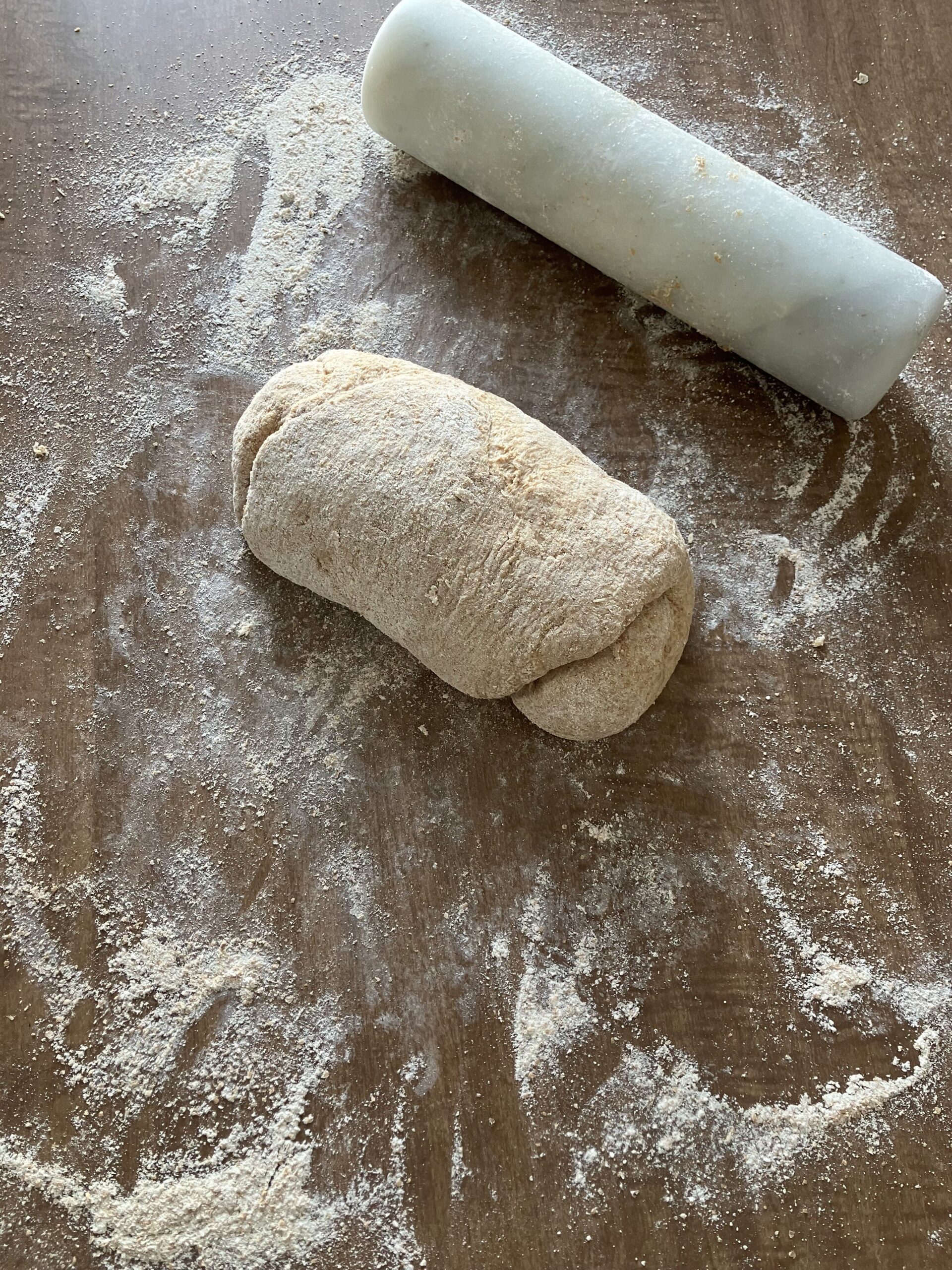
Making the switch to whole wheat
Baking with whole wheat flour seems to be slowly growing more popular today. It is on the rise right behind the surge in sourdough bakers and from scratch cooking that occurred a few years ago. There is a very good reason for this, and it is not because of the current trendy-ness of at home baking. It is because more information and awareness of nutrition is spreading.
I want to encourage you if you are on the fence about incorporating more whole wheat products into your diet, to just go ahead and take the plunge. It is not as complicated as it sounds to bake with whole wheat. Many people suggest starting by making your products with 75% whole wheat and 25% all purpose flour at first. My personal opinion is this is an unnecessary step. Just jump in; find recipes made with 100% whole wheat, and see what you get for results. The products actually taste so delicious, flavorful, and still have a great texture and density, especially with a little practice.
Now, why should anyone have an interest in baking with whole wheat versus all-purpose flour? Isn’t it good enough that you are simply making your food at home? To answer that question, I want to look at both the history of when white flour gained popularity in the nineteenth century, and compare the nutrition facts of the two flours for you. This will be an informational article looking at the available facts and science on the topic. I will cite my sources used at the end of the article.

The history
White flour gained popularity during the industrial revolution with the introduction of roller mills. This technology allowed the bran and germ to be separated from the endosperm making a finer flour with a longer shelf life. This was a market changing and monumental event for the flour industry which seemed to have only benefits for all involved. It appeared to be a demonstration of forward moving progress. The flour quickly became highly marketable for multiple reasons. 1) It could be made affordably. 2) It had a longer shelf life. 3) It was a versatile, very fine flour that improved the texture of many baked goods. However, it came at the expense of great nutritional loss. The flour made from the starchy endosperm component of the wheat berry, lost a lot of the vitamins, minerals, and fiber naturally contained in the bran and germ.
Malnutrition and enrichment
This nutrient loss is why all purpose flour that you buy in the store is enriched. This enrichment process began in the 1940s as a result of an increase in various diseases that were being traced back to a nutrient deficiency in the population. Pellagra was one the most notable examples on record. If you read Achievements in Public Health, 1900-1999: Safer and Healthier Foods, an article on the CDC website which I will cite below, it notes that this disease became prevalent in the early 1900s. It wasn’t until 1937 that pellagra was confirmed to be caused by a nutrient deficiency specifically in niacin. Niacin is a nutrient that has almost an 80% loss in unenriched white flour compared to whole wheat. Thiamine is another nutrient that also has just over an 80% loss and was attributed to other nutrient deficiencies at the time. I will address how I calculated these numbers when we take a look at the nutrition facts.
When many malnutritioned men began showing up to the draft for WW2 in the 40s, this prompted a greater focus on nutrition. The above mentioned article on the CDC notes that there were reports of 25% of draftees showing signs of past or present malnutrition. It is no surprise that this was the case coming out of the great depression. I’ll make a note here that during the great depression white bread was one of the most affordable and available staples. Correlation does not necessarily mean causation, but considering what we know today about the lack of nutrients in the white flour, it is reasonable to conclude that it did not help the situation; especially when diets were already limited due to cost and accessibility.
What is added back in?
The government started programs to enrich the white flour with thiamin, niacin, riboflavin, and iron to address these deficiencies. While these four synthetic nutrients helped the population to address the immediate health issues, they did not make up for the 15 other necessary to life nutrients that were still greatly diminished. Later, in 1998, they also added in folic acid when it was found that neural tube defects were clearly linked with folate deficiencies in early pregnancy.
It was interesting to me how drastically white flour changed the diets of multiple cultures in a very short amount of time with the introduction of a new piece of technology. What was also very interesting was the fact that nutrient deficiencies and diseases became such a prevalent issue in the years following. As I noted, this does not necessarily mean there is an undeniable cause and effect, but it is an observation worth considering. It makes complete sense when you understand that white flour is made from the endosperm of the wheat berry which is simply the starchy protein part of the seed. You lose most of the minerals, most of the vitamins, and just about all of the fiber contained in the whole wheat berry. So, lets take a look at the actual nutrition facts.
A look at the USDA nutrition facts
All purpose flour
100% whole wheat flour


Above are side by side comparisons of enriched all purpose flour and whole wheat flour. You will notice that there is a drop in all nutritional components aside from the 4 vitamins and 1 mineral that the flour is synthetically enriched with. I did quick math to find the percent loss between the two flours for most of the nutrients. (e.g. magnesium: 26.7 mg divided by 136 mg = .196. This figure means the all purpose flour contains 19.6% of the magnesium of whole wheat flour, or in other words there is an 80.4% loss.) I found that in general there is a 40-80% loss in just about every nutrient in the flour. Over three quarters of the nutrients were closer to 80% than 40%.
Unenriched
Let’s take a quick look at unenriched flour to see what the difference was before the enrichment process. I used the same process noted above when I got the figure of an 80% loss of niacin and thiamin which I discussed earlier. There is a stark 100% loss of riboflavin. Almost all of the fiber is lost. It drops from 10.6 grams to .5 grams – a 95% loss. Fiber and Riboflavin are the most lost nutrients in the white flour compared to whole wheat.


It is very clear that there is a stark difference in the nutrient component between the two flours. If you want to increase the natural nutrition in your diet and you are currently baking with all purpose flour, just switching to whole wheat can immediately increase your natural intake of a large variety of nutrients by 40-80%.
Just switching to whole wheat products can immediately increase your daily intake of key nutrients by 40% for some or up to 80%.
What about the 5 enriched vitamins and minerals?
You may be wondering about the 5 vitamins and minerals enriching the white flour and whether you should be concerned that whole wheat lacks them. While still a good source of each nutrient, the whole wheat does contain slightly less of each of the 5 than the enriched white flour. My best educated answer would be you should have an awareness that whole wheat flour is not an adequate source of these key nutrients. However, neither is enriched white flour.
The synthetic nutrients enriching white flour still do not supply your recommended daily value of these nutrients. With this awareness, consider what other ways you can incorporate these nutrients into your diet. For example, you can eat red meats to increase your iron or legumes, nuts, and leafy greens for the various B vitamins.
Closer look at folate
I wanted to specifically make a side note regarding folate. Folate is also found naturally in whole wheat flour, although not abundant. It has about 10% of the daily value in one slice of bread. A google search will tell you that 1 cup of cooked lentils boasts a little less than 100% supply of your daily value of folate (358 micrograms-the recommended daily value is 400 micrograms).
Thus, if you are trying to get pregnant, incorporating lentils in your diet alongside whole wheat bread, spinach, and other beans and peas would be great ways to provide for your body’s and eventually your small baby’s nutritional needs in that season. Please note, I am not suggesting to avoid prenatals. Prenatals are a power-house of vitamins needed by your body during pregnancy, and are recommended by doctors. It is just helpful to know and grow aware of the natural sources of those vitamins and minerals, as well!
Disclaimer
Out of concern for putting my opinions, research, and thoughts on the internet, I am going to give a quick disclaimer sentence. Obviously, I am a mom seeking to feed my family healthy and nutritious foods–not a doctor. Please don’t take anything I say as medical advice, and instead just be encouraged to do your own research!
Now for sourcing
Okay, so you want to switch to whole wheat baking, but where do you start? Well, let me encourage you that whole wheat flour is actually very easy to source in today’s day in age! We live in a unique time in history where access to good food is not the real problem, but rather knowledge on how to find it and how to use it.
Many local grocery stores carry various whole wheat flour options. I recommend King Arthur’s brand! The company is a reputable, American-based company that takes care to provide quality products to their customers. Since they are commonly sold in local grocery stores, they are one of the most readily available whole wheat flour options. You can buy local from your nearest grocery store, or you can order the flour directly from their website.
When I began baking with whole wheat I used their Golden whole wheat and their hard red whole wheat both of which I found at Hannaford, our local grocery store. Both of them worked well in all of the recipes that I tried, but my favorite for flavor and texture was the hard red whole wheat. You can shop their website to discover what else they offer, and to read more about the products and the company itself.
Can you buy in bulk?
If you are like me, you enjoy shopping sales and buying products in bulk to get discounts. The problem with buying whole wheat flour in bulk is that it is not as shelf stable as all purpose flour. This was one of the reasons that white flour has been so marketable for so long despite its nutritional deficits. You can counteract this by storing the flour in the fridge or the freezer to prolong it’s shelf life.
There are few places that I have found where you can actually buy whole wheat flour in bulk. Azure standard is the place I would recommend checking out to find bulk deals. They sell a variety of fresh flours or whole grains.
Buying grain versus flour

When I switched to baking with whole wheat flour, I quickly made the decision to get set up with an at home grain mill and to buy the grain itself. I chose to do this primarily for the health benefits that I was reading and learning about, the cost savings, and storage. I can buy grain in bulk for just a few cents more than all purpose flour per pound, and grain stored properly will last for years. It intrigued me that I could make one bulk purchase, store my grain properly, and have access to an abundance of one of our most basic and necessary staples indefinitely depending on how much I purchased.
If you are interested in home milling and it’s health benefits, this article: Fresh Milled Flour vs. Store-Bought: What the Science Actually Shows is a very well-written, honest look at the science that is available on the topic. Many articles that I have come across discussing fresh milled flour do not cite sources and make exaggerative claims. However, this one takes a clear look at available information to discuss the science and cites their sources.
Where to purchase?
At the time of writing this blog post, Azure Standard has the best prices on a variety of grains that I have found. I was very excited when I discovered that they have a drop located near me. Azure standard is a natural health foods distributor that sells bulk, quality health food at generally reasonable prices. They carry a variety of products beyond grains and flours, and they are committed to providing quality goods all throughout the United States.
You can check out Azure’s website to learn how the shipping and drop points work and to see what they carry for products. I am participating in the share program, and if you make your purchase through this link, I will earn store credit. This program is available for any customer of Azure standard to participate in. Which means if you place your order, you can share it with others and earn store credit, as well! Check them out.

Sources:
“Achievements in Public Health, 1900-1999: Safer and Healthier Foods.” Centers for Disease Control and Prevention, Centers for Disease Control and Prevention, www.cdc.gov/mmwr/preview/mmwrhtml/mm4840a1.htm. Accessed 15 June 2026.
“Fooddata Central Frontpage.” USDA FoodData Central, fdc.nal.usda.gov/. Accessed 15 June 2026.
Judy. “Fresh Milled Flour vs. Store-Bought: What the Science Actually Shows.” KitchLit, 12 May 2026, kitchlit.com/fresh-milled-flour-vs-store-bought-flour/.
Springate, Megan E. “Nutrition on the Home Front in World War II (U.S. National Park Service).” National Parks Service, U.S. Department of the Interior, www.nps.gov/articles/000/nutrition-on-the-home-front-in-world-war-ii.htm. Accessed 15 June 2026.
“Why Is Flour Enriched and What Does It Replace?” ScienceInsights, 20 Mar. 2026, scienceinsights.org/why-is-flour-enriched-and-what-does-it-replace/.
Leave a Reply